

The best sea moss pills are the ones with a named harvest origin, third-party heavy-metal testing on every batch, around 1,000 mg of actual sea moss per serving, and nothing else in the capsule. That rules out more of the market than you'd think. We're a sea moss brand, so you should read what follows knowing that. But we're going to give you the checklist rather than a ranking, because a ranking from us would be worthless and a checklist you can hold up against any label.
If you've searched this question, you've already seen the "10 Best Sea Moss Capsules" pages. Almost all of them are affiliate sites that earn a commission on whatever you click, and the order of the list usually tracks the commission rate. Here's how to do it yourself in about five minutes per brand.
1. Where was it harvested?
This is the first question and the one most brands dodge. Sea moss absorbs whatever's in the water around it. That's the whole reason it's mineral-rich, and it's also why sea moss from polluted or stagnant water can carry arsenic, lead, and cadmium. A brand that can tell you "wildcrafted off the coast of St. Lucia" or "harvested in the North Atlantic" has a supply chain it can trace. A brand that says "sourced from pristine waters" with no location is telling you it doesn't know, or doesn't want you to.
The other half of this question is wild versus pool-grown. Pool-grown sea moss is raised in tanks with salt water and fertilizer. It looks cleaner and grows faster, and it has a narrower mineral profile because it only absorbs what's added to the tank. A lot of it gets sold as "wildcrafted" anyway. We cover how to tell them apart in Wildcrafted vs. Organic Sea Moss.
What to look for: a named country or region, and the word "wildcrafted" backed by that origin.
2. Is it third-party tested, and will they show you?
"Lab tested" on a label means almost nothing on its own. The questions are: tested by whom, for what, how often, and can you see the results. The answer you want is an independent lab, heavy metals plus microbial contaminants, every batch, and a certificate of analysis you can actually look at.
Try it. Email a brand and ask for the most recent COA for the product you're considering. If you get a PDF back within a couple of days, that's a good sign. If you get a marketing reply or silence, you have your answer. Better still is a brand that doesn't make you ask: ours are on the Third Party Lab Results page, by product and lot number, with a link to each certificate.
What to look for: "third-party tested" with the COA published or available on request. GMP-certified manufacturing is a plus.
3. How much sea moss is actually in the capsule?
Turn the bottle around and read the supplement facts panel, not the front. The front might say "Sea Moss 1,500 mg." The panel might say that's per two-capsule serving, and that the 1,500 mg includes bladderwrack and burdock root with the sea moss portion unlisted. Or it says "proprietary blend," which means they don't have to tell you.
A straightforward product lists sea moss as a named ingredient with a milligram amount. Around 1,000 mg of dried sea moss per serving is a sensible daily dose; we explain why in How Much Sea Moss Per Day? Much less than that and you're paying for capsules of mostly air. Much more and you're mostly adding iodine you don't need.
What to look for: sea moss listed by name with a milligram figure, roughly 1,000 mg per serving.
4. What else is in there?
The ingredient list on a plain sea moss capsule should be about two lines: organic sea moss, vegetable capsule. Maybe a flow agent. If you're buying a blend, a few named botanicals at stated doses is fine. What you want to avoid is a long list of fillers (rice flour, maltodextrin, microcrystalline cellulose in large amounts) that exist to make a small amount of sea moss fill a large capsule.
Also check whether it's actually organic. USDA Organic certification on a sea moss product means the handling and processing have been audited. It isn't a heavy-metal test, but it's a sign of a supply chain somebody is checking.
What to look for: a short ingredient list. USDA Organic seal if you can get it.
5. What's the real price per serving?
Bottle price is misleading because capsule counts and serving sizes vary. Do the math: bottle price divided by number of servings (not capsules). A $25 bottle with 60 capsules at two per serving is $0.83 a day. A $30 bottle with 90 capsules at one per serving is $0.33 a day. The cheaper-looking bottle costs more than double.
Very low prices are also a flag. Wildcrafted, tested, organic sea moss has a real cost. If a brand is selling it for a fraction of what everyone else charges, something on the list above is missing.
The checklist
| Check | Pass | Fail |
|---|---|---|
| Origin | Named region, wildcrafted | "Pristine waters," no location, or pool-grown sold as wild |
| Testing | Third-party, every batch, COA published or on request | "Lab tested" with nothing behind it |
| Dose | ~1,000 mg sea moss, listed by name | Proprietary blend or sea moss amount hidden |
| Ingredients | Sea moss + capsule, or a short named blend | Long filler list |
| Price per serving | Calculated from servings, in line with the market | Suspiciously cheap or inflated by small servings |
Where we land on each
Since we'd be annoyed if a brand wrote this article and then didn't answer its own questions:
- Origin: wildcrafted, with the harvest region on our product pages.
- Testing: every batch is third-party tested for heavy metals and microbials, made in a GMP-certified facility in the USA. The results are on our Third Party Lab Results page.
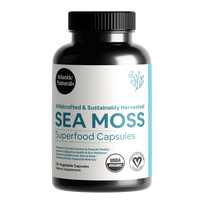
- Dose: Organic Sea Moss Capsules are 1,000 mg of sea moss per serving, listed by name.
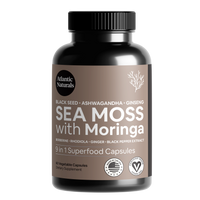
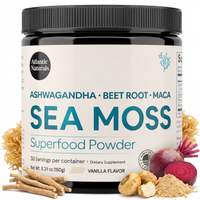
- Ingredients: organic sea moss and a vegetable capsule. The blends (Spirulina, Beet Root, Shilajit 5-in-1, Moringa 9-in-1) name every addition with its amount.
- Price: you can do the math on the product page. We're not the cheapest and we're not trying to be.
You can buy from us or not. Either way, run whatever you pick through the five checks. Most of what's on Amazon fails at least two.
Frequently asked questions
Which sea moss capsules are the best quality?
The ones with a named wildcrafted origin, third-party heavy-metal testing on every batch, about 1,000 mg of sea moss per serving listed by name, and a short ingredient list. Compare brands on those five points rather than on reviews or price alone.
Are Amazon sea moss capsules safe?
Some are, many aren't verifiable. Amazon doesn't require testing, so check the brand's own site for certificates of analysis and a harvest origin before buying there.
Is organic sea moss better than wildcrafted?
They answer different questions. Wildcrafted describes where it grew (open ocean). Organic describes how it was handled and audited. The best products are both, but if you have to choose, a tested wildcrafted product beats an untested organic one.
How much should sea moss capsules cost?
Work it out per serving, not per bottle. Properly sourced and tested sea moss generally runs somewhere between thirty cents and a dollar a day. Well below that range, something's been cut.
New to sea moss capsules? Start with our full guide, Sea Moss Capsules: What They Do, Whether They Work, and How to Take Them. If you're buying raw sea moss rather than capsules, How to Spot Fake vs. Real Sea Moss covers the physical tells.
These statements have not been evaluated by the Food and Drug Administration. This product is not intended to diagnose, treat, cure, or prevent any disease.


Leave a Comment