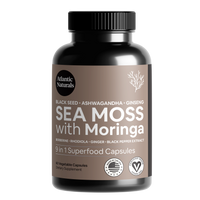


Here's the short answer. If you're using gel, 1 to 2 tablespoons a day (roughly 4 to 8 grams) is the usual amount. Capsules land around 1,000 to 2,000 mg. Powder, 1 to 2 teaspoons. Gummies and drink mixes are a serving or two of whatever the package calls a serving. The one thing worth saying up front is that sea moss carries iodine naturally, so the label serving matters more than the size of your scoop. Below I'll walk through each format, when people take it, and how to tell if you've wandered past the amount you actually need.
Sea Moss Dosage at a Glance
Brands portion things differently, so your label is always the real authority. But these are the ranges you'll run into again and again:
| Format | Typical Daily Amount | Notes |
|---|---|---|
| Sea moss gel | 1–2 tablespoons (4–8 g) | Refrigerate; use within the product's stated shelf life |
| Capsules | 1,000–2,000 mg | Most convenient for consistent, measured servings |
| Powder | 1–2 teaspoons (2–5 g) | Blends into smoothies; check whether it's a blend or pure sea moss |
| Gummies | 1–2 gummies | Sea moss content per gummy varies widely by brand |
| Drink mixes | 1 serving (stick or scoop) | Often paired with electrolytes or other ingredients |
Sea Moss Dosage by Format
Sea Moss Gel: 1–2 Tablespoons Daily
Gel is the old-school way, and still the one plenty of people swear by. A tablespoon of prepared gel comes out to about 4 grams of hydrated sea moss. One to two tablespoons a day does the job for most. Eat it off the spoon if you like, or stir it into a smoothie, oatmeal, or tea. It also works as a thickener in recipes.
Two things to keep in mind. Gel is perishable, so it lives in the fridge and gets used within the window your supplier gives you. And if you make your own, the concentration shifts with how much water you blend in. Keep the recipe the same batch to batch and your daily amount stays steady on its own.
Capsules: 1,000–2,000 mg Daily
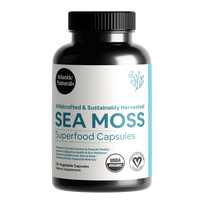
Capsules are the easiest way to take the same measured amount every single day. No blending. No fridge. No eyeballing a spoon. A common serving is 1,000 mg of dried sea moss, which is what you'll find in our Organic Sea Moss Capsules. Dried sea moss is a lot more concentrated than the hydrated gel, so 1,000 mg goes further than the number lets on next to "a tablespoon of gel."
One serving a day, 1,000 mg, is where most people are happy to sit. Some go up to 2,000 mg. There's rarely much reason to push past the label's suggested use, and the iodine section coming up explains why.
Powder: 1–2 Teaspoons Daily
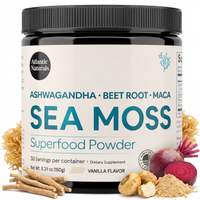
Powder is just dried, milled sea moss you can stir or blend into a drink. A teaspoon of the pure stuff runs about 2 to 3 grams. If yours is a blend instead of pure sea moss, go by the blend's serving size rather than guessing from grams. Our Sea Moss Superfood Powder with Ashwagandha, Beet Root, and Maca is built that way. One scoop gives you a measured dose of sea moss plus the other botanicals, so the label serving is simply your daily amount.
Powder makes sense if you already blend a smoothie every morning. You fold it into a habit you've got instead of tacking on one more step.
Gummies: Follow the Label Closely
Gummies are where serving sizes swing the hardest from brand to brand. Some pack a few hundred milligrams of sea moss each. Others hold much less, propped up by fillers and sweeteners. Read the supplement facts panel for the real sea moss content per gummy, and treat the label serving as your ceiling. They taste like candy. They're still a supplement.
Drink Mixes and Hydration Sticks: One Serving Per Day
Drink mixes fold sea moss in with hydration-friendly ingredients, which makes them handy for mornings, workouts, or a suitcase. One stick or scoop is your complete serving. Our Sea Moss Hydration sticks carry 800 mg of sea moss each, plus electrolytes, so a single stick covers your daily sea moss with zero measuring.
Using a drink mix and another sea moss product on the same day? Add them together. What counts is your total daily sea moss, not each product on its own.
The Iodine Consideration: Why More Isn't Better
Sea moss (Chondrus crispus) is a sea vegetable, and sea vegetables carry iodine naturally. Iodine is a mineral your thyroid uses to make the hormones that help regulate metabolism and energy. You need it. But it's the kind of nutrient where the right amount is a range, not a target you try to beat. The National Institutes of Health puts the recommended dietary allowance for most adults at 150 micrograms a day, with a tolerable upper intake level of 1,100 micrograms a day.
So here's the practical part. How much iodine sea moss holds shifts with where and when it was harvested. Take several times the label serving "for extra benefit" and mostly what you've taken is several times the iodine. Not several times the benefit. Standard servings from a decent product are portioned with that in mind. It's one of the clearest reasons to treat the label serving as your target instead of a floor to build up from.
Who Should Talk to Their Healthcare Provider First
Because of that iodine, a handful of people should check with their healthcare provider before working sea moss into a routine:
- Anyone with a thyroid condition, or anyone on thyroid medication, since iodine intake is something a provider may already be keeping an eye on
- Women who are pregnant or breastfeeding, because iodine needs and limits shift during that stretch
- Anyone on prescription medications, blood thinners especially, as a general supplement precaution
- Anyone already taking other iodine-containing supplements like kelp, so you don't double up without meaning to
None of that makes sea moss some special case. It's the same conversation worth having before you start any new supplement. It just reflects that sea moss is a genuinely mineral-rich food.
When to Take Sea Moss: Timing and Food
There isn't a "correct" hour of the day for this. What the research on supplement habits keeps pointing to is that the best time is the time you'll actually remember. Here's how it tends to shake out:
- Morning: the popular pick. Capsules with breakfast, gel in a morning smoothie, or a hydration stick in that first glass of water ties the habit to a routine you've already got.
- Evening: works just as well. If your mornings are a scramble, capsules with dinner keep you just as consistent.
- With or without food: either way is fine. Taking it with food or a full glass of water is a comfortable default, especially for capsules, and can sit easier on a sensitive stomach.
Splitting your serving is fine too, with one capsule in the morning and one at night. Just keep the daily total inside the label's suggested use.
Consistency Beats Megadosing
Sea moss is a whole-food supplement. Not a quick fix. It does its best work as a steady daily thing. A standard serving every day for weeks will always beat triple servings for three days and then forgetting the bottle exists. Your body doesn't bank the surplus, and as we covered, the oversized amounts mostly just hand you iodine you didn't need.
A few ways to make it stick:
- Attach your serving to something you already do, like morning coffee, the daily smoothie, or brushing your teeth before bed
- Pick the format that fits your life. Capsules for travel and packed days. Powder if you're already blending. Hydration sticks if you're trying to drink more water anyway.
- Keep it in sight. A bottle next to the coffee maker gets taken. One in a cabinet gets forgotten.
Signs You May Be Taking Too Much
Stay inside label servings and most people get along with sea moss fine. The signs you've overshot, usually from stacking products or going well past the suggested serving, tend to be:
- Digestive discomfort. Bloating, loose stools, an unsettled stomach. Large amounts of any fiber-rich sea vegetable can do this.
- A metallic or brassy taste, which can ride along with high iodine intake.
- Feeling generally "off" after a big jump in your amount. Unusual fatigue or jitteriness is a cue to ease back.
If any of that shows up, drop back to (or under) the standard serving, take stock of every iodine source in your routine, and talk to your healthcare provider if it hangs around. Stop use and check with your provider if you have a reaction that worries you.
Finding Your Format
The right dose isn't really a magic number. It's a sensible serving, taken consistently, in a format you'll actually stick with. Maybe that's 1,000 mg capsules. Maybe a scoop of superfood powder, or an 800 mg hydration stick. You can compare every option in our full sea moss collection, all made with USDA Organic sea moss and clearly labeled serving sizes.
Frequently Asked Questions
How much sea moss should I take per day?
Typical daily amounts are 1–2 tablespoons of gel, 1,000–2,000 mg in capsules, 1–2 teaspoons of powder, or one serving of a gummy or drink-mix product. Follow your specific product's label, since serving sizes vary by brand and format.
Is 1,000 mg of sea moss enough?
For most people, yes. A 1,000 mg serving of dried sea moss, the serving in our Organic Sea Moss Capsules, is a standard daily amount. Dried sea moss is more concentrated than hydrated gel, so the serving is more substantial than the number suggests.
Can I take sea moss every day?
Yes. Daily use at the label serving size is exactly how sea moss is designed to be taken, and consistency is more important than the size of any single serving. Just avoid stacking multiple sea moss or iodine-containing products without accounting for the combined total.
Should I take sea moss in the morning or at night?
Either works. There's no evidence that one time of day is better; the best time is whichever you'll remember consistently. Many people take it in the morning with breakfast or a smoothie, but with dinner is equally fine, with or without food.
Who should not take sea moss?
Anyone with a thyroid condition, anyone taking thyroid or other prescription medications, and women who are pregnant or breastfeeding should talk to their healthcare provider before taking sea moss, primarily because of its natural iodine content. The same goes for anyone already using other iodine-containing supplements such as kelp.
These statements have not been evaluated by the Food and Drug Administration. This product is not intended to diagnose, treat, cure, or prevent any disease.


Leave a Comment