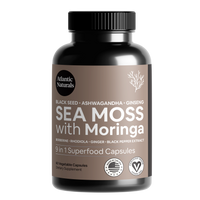
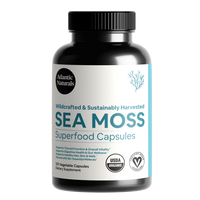

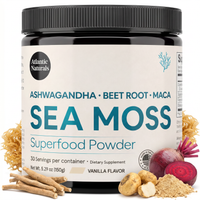


No, sea moss doesn't burn fat, and no capsule flattens a stomach. We sell sea moss and we're telling you that up front because the alternative is the kind of marketing that makes people distrust the whole category. What sea moss can do is more modest: the fiber in it helps some people feel fuller and less bloated, and for people who were low on iodine, fixing that can bring energy back. Those things can support a weight-management effort. They don't replace one.
If you came here from a video promising a flat stomach in two weeks, we're sorry. Here's what the evidence and our own experience actually support.
What sea moss can do
Fullness from fiber
Sea moss is largely soluble fiber and mucilage. In the stomach it absorbs water and forms a gel, which takes up space and slows how fast food leaves. That's the same mechanism behind oats, chia, and psyllium, and it's why a serving of sea moss before or with a meal can take the edge off appetite for some people. The effect is real but small. It's a nudge, not a switch.
Less bloating
This is where the "flat belly" idea comes from, and there's something to it, just not what the videos claim. A lot of what people call belly fat is actually bloating: gas and water retention from irregular digestion. Soluble fiber supports regularity, and regular digestion tends to mean a less distended stomach. So some people do look and feel flatter after a few weeks on sea moss. That's not fat loss. It's a stomach that's working better. Worth having, and worth being honest about.
Fair warning: the first week can go the other way. New fiber often means a few days of gas before the gut adjusts. Start with half a serving.
Energy, if iodine was the problem
The thyroid uses iodine to make the hormones that set your metabolic rate. If you're not getting enough iodine, and a meaningful share of American adults aren't, your thyroid runs slow and so do you. Sea moss carries iodine, and a daily serving can close that gap over a month or two. For someone who was low, that can feel like getting their energy back, and people with more energy tend to move more. That's the indirect path from sea moss to the scale.
The catch is that if your iodine is fine, more iodine does nothing for your metabolism. It doesn't speed up a healthy thyroid. It just adds iodine, and too much of that causes its own problems. Sea moss is not a metabolism booster for the general population.
What sea moss can't do
- Burn fat. No ingredient in sea moss has a fat-burning action. Anyone claiming otherwise is making it up.
- Target belly fat. Nothing targets fat in one spot. Not sea moss, not anything.
- Replace a calorie deficit. Weight loss comes from eating less than you burn. Sea moss can make that slightly easier through fullness. It can't do it for you.
- Work in two weeks. If you see a two-week transformation attributed to sea moss, it's water weight, a diet change, or an edit.
How people actually use it for weight management
The customers who tell us sea moss helped them with weight are almost always doing the same thing: taking a measured serving with their first meal, drinking more water than usual, and using it as part of a routine that also includes eating better and moving more. The sea moss is a supporting habit. It shows up at the same time every day, it helps them feel less hungry mid-morning, and it keeps their digestion steady while they change what they eat. That's a sensible use. Treating it as the plan itself is not.
A practical version:
- One serving (1,000 mg capsule or a tablespoon of gel) with breakfast and a full glass of water
- Half serving the first week while your gut adjusts
- Give it six to eight weeks before judging anything
- Track how you feel at 3 p.m., not just the scale
Sea moss and "detox" or "cleanse" claims
You'll see sea moss sold as a detox. Your liver and kidneys detox you; sea moss doesn't. What a fiber-rich cleanse product can do is support regular digestion, which can relieve bloating and make you feel lighter. That's the honest version of the claim, and it's the only version we make about our own cleanse products.
At a glance
| Claim | Verdict | What's actually happening |
|---|---|---|
| Burns fat | No | No fat-burning mechanism exists in sea moss |
| Flattens your belly | Partly | Fiber can reduce bloating; that's not fat loss |
| Reduces appetite | Modestly | Soluble fiber forms a gel that slows stomach emptying |
| Boosts metabolism | Only if iodine was low | Fixes a slow thyroid caused by iodine shortfall; does nothing for a normal one |
| Detoxes the body | No | Liver and kidneys do that; fiber supports regularity |
Frequently asked questions
Does sea moss help you lose weight?
Not directly. It has no fat-burning effect. Its fiber can help you feel fuller and less bloated, and for people low on iodine it can support normal energy, both of which can make a weight-management effort easier. It won't cause weight loss on its own.
Does sea moss flatten your stomach?
It can reduce bloating by supporting regular digestion, which some people experience as a flatter stomach. It does not reduce belly fat.
How much sea moss should I take for weight loss?
The same as for anything else: a normal daily serving, around 1,000 mg in capsules or a tablespoon of gel. Taking more doesn't increase any effect and mostly adds iodine.
Does sea moss boost metabolism?
Only in the sense that its iodine supports a thyroid that was short on iodine. For people whose iodine intake is already adequate, it has no metabolism-boosting effect.
Can sea moss make you gain weight?
No. It has almost no calories. In the first week some people retain a little water as their gut adjusts to the fiber, which passes.
If you want sea moss as a daily habit, one Organic Sea Moss Capsule with breakfast is the simplest version. For a realistic sense of when you'd notice anything, read How Long Does It Take for Sea Moss to Work?, and for the full picture, Sea Moss Capsules: What They Do, Whether They Work, and How to Take Them.
This article is for informational purposes only and is not medical advice. These statements have not been evaluated by the Food and Drug Administration. These products are not intended to diagnose, treat, cure, or prevent any disease.


Leave a Comment