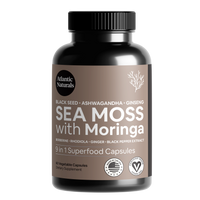
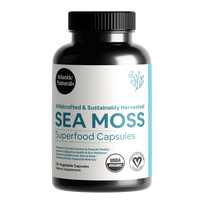

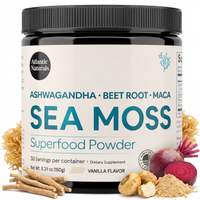


Sea moss sold as a supplement comes from one of two very different places: rocky, cold-water coastline where it grows wild, or a plastic-lined pool filled with brine. Wildcrafted sea moss is hand-harvested from its natural ocean habitat, the kind of environment where it's been growing for a very long time. Pool-grown sea moss is cultivated in tanks that mimic seawater but never quite replicate it, and the mineral profile shows the difference. Atlantic Naturals sources wildcrafted sea moss from Nova Scotia's North Atlantic coastline, and that distinction is the whole reason it ends up in our capsules instead of something grown in a warehouse.
Here's what actually happens between a rock in cold water and a capsule in your kitchen cabinet.
What is sea moss, exactly?
"Sea moss" is the common name for Chondrus crispus, a red algae species. Not a moss at all, despite the name. It grows attached to rocks in the intertidal and subtidal zones of the North Atlantic, meaning it spends part of its life submerged and part exposed at low tide. It's been part of coastal food traditions in Ireland and the Caribbean for generations, usually simmered into a gel and used the way you'd use a thickener.
Chondrus crispus grows in cold, rocky, nutrient-rich water. The North Atlantic coastlines of Canada, Ireland, and parts of New England are classic habitat. It needs that specific combination: cold temperatures, high water movement, and a rocky surface to anchor to. That's not a marketing detail. It's just where the species actually lives.
Why does Nova Scotia water matter?
Cold water holds more dissolved oxygen and tends to support slower, denser growth in marine algae. Nova Scotia's coastline also sits far from major industrial runoff compared to a lot of coastal water worldwide, which matters a great deal for something that absorbs minerals directly from its surroundings. The water isn't just backdrop. It's the input. Sea moss doesn't have roots pulling nutrients from soil the way a land plant does. It draws everything, minerals included, straight from the water column around it. Cold, clean, mineral-rich water is the whole reason wildcrafted Nova Scotia sea moss has the reputation it does.
Wildcrafted vs. pool-grown: what's the actual difference?
This is the distinction that matters most, and it's worth being precise about it.
Wildcrafted sea moss
Wildcrafted means harvested by hand from where it naturally grows: rocky shoreline, real ocean water, real tidal cycles. Harvesters go out at low tide, hand-pull the moss from the rocks it's attached to, and bring it in for processing. It's manual, weather-dependent work, and the moss comes out of an environment it's been adapted to for a very long time.
Pool-grown sea moss
Pool-grown (sometimes called tank-grown) sea moss is cultivated in constructed brine tanks: essentially large pools filled with a salt water mixture meant to approximate ocean conditions. It's faster to produce, easier to control, and cheaper to scale. But a brine tank is not the ocean. It doesn't replicate the full mineral complexity, the water movement, or the microbial environment of an actual coastline. Pool-grown sea moss never develops the same mineral profile as wildcrafted moss. That's a difference we've seen consistently, and it's a core reason we don't source that way.
Neither version is fake sea moss, to be clear. It's the same species, grown differently. But "sea moss" on a label doesn't tell you which one you're getting, and the two aren't interchangeable in terms of what ends up in the final product.
What does hand-harvesting actually look like?
It's low-tech and weather-dependent, which is part of why it doesn't scale the way a brine tank does. Harvesters work the intertidal zone at low tide, when the rocks the moss grows on are exposed or shallow enough to reach. The moss is pulled by hand, not dredged or machine-cut, which limits how much can be collected in a given window and means the work follows the tides and the season rather than a factory schedule.
We're not going to invent details we can't stand behind. No specific crews, no named coves, no harvest quotas. What we can say honestly is that it's manual work tied to a natural cycle, done on a coastline that's been productive habitat for this species for a long time. That's a slower, less predictable process than filling a tank on a schedule, and it's also the reason wildcrafted moss carries the mineral signature it does.
How does harvested sea moss become a capsule or powder?
Once sea moss is pulled from the water, it goes through a few standard steps before it's shelf-stable:
- Rinsing. Removing sand, debris, and other marine material picked up during harvest.
- Drying. Sea moss is dried down substantially. Fresh, wet moss is mostly water weight, and drying is what makes it stable enough to store and ship without spoiling.
- Grinding. Dried moss is milled into a powder, which is either encapsulated directly or used as the base for other formats.
- Testing. Before anything gets packaged for sale, a batch needs to be verified for purity and contaminant levels. More on why that step isn't optional below.
None of this is exotic processing. It's closer to how you'd dry and mill any other dried food product. The complexity is upstream, in getting a consistent, clean raw material in the first place, not in the drying and encapsulation itself.
Why does seaweed need third-party testing?
Because of the same property that makes it nutritionally interesting: it absorbs whatever is in its environment, good and bad. Sea moss pulls minerals from seawater because it has no other way to feed itself. That process doesn't discriminate. If a coastal area has heavy metal contamination, algae grown there will reflect it. This isn't unique to sea moss. It's true of most seaweed and a fair number of other minimally processed marine products.
That's exactly why testing matters more here than it might for a land-grown crop with more controllable inputs. Every Atlantic Naturals batch is third-party lab tested before it's sold, and we publish the results at our lab results page. We'd rather you check that page and see the numbers than take our word for it. "Trust us" isn't a testing program.
Wildcrafted vs. pool-grown, side by side
| Factor | Wildcrafted sea moss | Pool-grown sea moss |
|---|---|---|
| Growing environment | Natural ocean coastline, real tidal water | Constructed brine tanks approximating seawater |
| Mineral profile | Reflects full complexity of ocean water | Narrower, shaped by the tank's mixed brine |
| Harvest method | Hand-harvested from rocks at low tide | Collected from cultivation pools |
| Production speed | Slower, seasonal, weather-dependent | Faster, more controllable, scalable |
| Testing need | Still requires third-party contaminant testing | Still requires third-party contaminant testing |
What should you actually look for when buying sea moss?
Two things, mainly. First, whether the moss is wildcrafted and where it's from. A brand that's specific about sourcing has less reason to hide it. Second, whether there's published third-party lab testing you can actually look at, not just a claim that testing happens somewhere. Atlantic Naturals sources wildcrafted sea moss from Nova Scotia and tests every batch, and both of those facts are things you can verify rather than take on faith.
Our Organic Sea Moss Capsules ($27.99) are wildcrafted from Nova Scotia waters and third-party tested batch by batch. No brine tank, no shortcuts on the sourcing side.
FAQ
Is sea moss actually a moss?
No. Sea moss is the common name for Chondrus crispus, a species of red algae. The name is a holdover from tradition, not a botanical description.
What's the difference between wildcrafted and pool-grown sea moss?
Wildcrafted sea moss is hand-harvested from its natural ocean habitat. Pool-grown sea moss is cultivated in constructed brine tanks meant to approximate seawater. Pool-grown moss never develops the same mineral profile as wildcrafted moss.
Why does sea moss need to be lab tested?
Because it absorbs whatever is in the water it grows in, including contaminants if the water carries them. Third-party testing verifies purity and contaminant levels before a batch is sold.
Where does Atlantic Naturals source its sea moss?
Wildcrafted from Nova Scotia's North Atlantic coastline, and every batch is third-party lab tested. Results are published at our third-party lab results page.
Why does Nova Scotia water matter for sea moss quality?
Cold, nutrient-rich, relatively clean water supports the dense, mineral-rich growth Chondrus crispus is known for. Since sea moss draws its minerals directly from the surrounding water, the quality of that water is a direct input into the final product.
For more on sourcing and how to use sea moss day to day, see our guide on how much sea moss per day and our sea moss side effects guide. You can browse the full lineup, including Sea Moss Hydration, in our sea moss collection.
These statements have not been evaluated by the Food and Drug Administration. This product is not intended to diagnose, treat, cure, or prevent any disease.


Leave a Comment