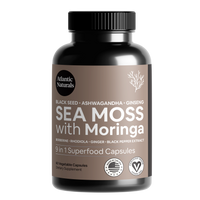
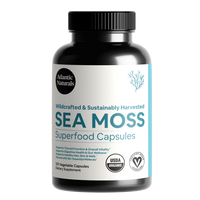

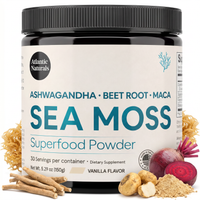


There's no supplement that's better than sea moss across the board, and there's no supplement sea moss beats across the board either. It depends what you want. If you only want iodine, kelp does it cheaper and more precisely. If you want protein and B vitamins, spirulina wins easily. If you want one pill that covers the most boxes, that's a multivitamin. What sea moss does that none of those do is deliver a wide spread of ocean minerals plus soluble fiber from a single whole food. That's a specific thing, and it's either what you're looking for or it isn't.
We sell sea moss, so take the framing with that in mind. But we'd rather you buy the right product from someone else than the wrong one from us. Here's the comparison we'd want if we were shopping.
Sea moss vs. kelp
Kelp is a brown seaweed and it's the iodine heavyweight. Gram for gram it carries far more iodine than sea moss, which makes it the better choice if iodine is the only thing you want and you want it in a known, consistent dose. It's also cheaper.
The flip side is that kelp's iodine content is high enough that it's easy to overshoot the 1,100 mcg daily upper limit, especially if you're also eating iodized salt or taking a multivitamin. Sea moss carries iodine at a gentler level with a broader mineral profile around it, plus fiber that kelp capsules mostly lack.
Pick kelp if: you want a precise iodine supplement and nothing else. Pick sea moss if: you want iodine as part of a wider mineral and fiber package.
Sea moss vs. spirulina
Spirulina is a blue-green algae and it's a different animal. It's about 60% protein by dry weight, rich in B vitamins and iron, and has a strong research base for antioxidant activity. It's a nutrient-dense green, not a mineral supplement.
Sea moss has much less protein and fewer vitamins, but a wider mineral spread, more iodine (spirulina has almost none), and the fiber. They don't really compete; they stack. That's why we make a Sea Moss with Spirulina capsule rather than trying to argue one over the other.
Pick spirulina if: you want plant protein, B vitamins, and antioxidants. Pick sea moss if: you want minerals and iodine. Take both if: you want all of it.
Sea moss vs. chlorella
Chlorella is spirulina's close cousin: a green freshwater algae, high in protein and chlorophyll, often sold for "detox" because it binds to some heavy metals in lab studies. Like spirulina, it has very little iodine and no meaningful fiber.
Pick chlorella if: you want a green with a chlorophyll focus. Pick sea moss if: you want ocean minerals and fiber. Same stacking logic as spirulina.
Sea moss vs. shilajit
Shilajit is a mineral-rich resin from mountain rock, prized in Ayurvedic tradition and sold mostly for fulvic acid and trace minerals. It has some human research around energy and testosterone in men, more than sea moss has. It contains no fiber and no iodine, and quality control is a bigger problem than with sea moss because the raw material is scraped off cliffs and often adulterated.
We've written this one up in full: Sea Moss vs. Shilajit: Which Is Right for You? The short version is that they complement rather than replace each other, which is why our 5-in-1 has both.
Sea moss vs. a multivitamin
A good multivitamin covers more nutrients than sea moss does, in known doses, for less money. If you're trying to cover the most possible gaps with one pill, the multivitamin wins and it isn't close.
What it doesn't give you is whole-food form, fiber, or the long tail of trace minerals that aren't on a multivitamin label because nobody's set an RDA for them. Whether that matters to you is a personal call. Plenty of our customers take both, which is fine as long as you check the multivitamin for iodine so you're not doubling up.
Pick a multivitamin if: you want broad insurance in precise doses. Pick sea moss if: you prefer a whole-food source and want the fiber.
Sea moss vs. a fiber supplement
If the digestive benefit is what drew you to sea moss, psyllium husk is cheaper, more concentrated, and better studied for regularity. It has no minerals and no iodine. Sea moss gives you a smaller fiber dose with the minerals attached.
The comparison table
| Supplement | Best for | Iodine | Fiber | Protein | Where sea moss wins |
|---|---|---|---|---|---|
| Kelp | Precise iodine | Very high | Low | Low | Gentler iodine, wider minerals, fiber |
| Spirulina | Protein, B vitamins | None | Low | High | Iodine, minerals, fiber |
| Chlorella | Chlorophyll, greens | None | Low | High | Iodine, minerals, fiber |
| Shilajit | Fulvic acid, trace minerals | None | None | None | Iodine, fiber, easier quality control |
| Multivitamin | Broad coverage | Often | None | None | Whole-food form, fiber, trace minerals |
| Psyllium | Fiber | None | Very high | None | Minerals and iodine with the fiber |
So what should you take?
Decide what gap you're filling. Low on iodine and minerals with a diet thin on seafood and sea vegetables? Sea moss is a good fit. Want protein and greens? Spirulina. Want one pill for everything? Multivitamin. Want digestion only? Psyllium. The mistake is buying sea moss because it's popular and then being disappointed that it didn't do what spirulina does. We'd rather lose the sale than have you make it.
Frequently asked questions
Is there anything better than sea moss?
For specific goals, yes. Kelp for iodine alone, spirulina for protein, a multivitamin for broad coverage, psyllium for fiber. Nothing else combines ocean minerals, moderate iodine, and soluble fiber in one whole food the way sea moss does.
Is spirulina better than sea moss?
For protein, B vitamins, and antioxidants, yes. For iodine, minerals, and fiber, no. They complement each other and many people take both.
Is kelp better than sea moss?
If you only want iodine, kelp gives more of it per dose. Sea moss offers a gentler iodine level with a broader mineral profile and fiber, which makes it harder to overdo.
Can I take sea moss with a multivitamin?
Yes, as long as you check whether the multivitamin contains iodine so you aren't stacking two sources.
Is shilajit better than sea moss?
They're different. Shilajit has more research around energy in men and provides fulvic acid; sea moss provides iodine, minerals, and fiber. Quality control is harder with shilajit.
If sea moss is the right fit, our capsule collection has it plain or paired with spirulina, beet root, or shilajit. For the full rundown on what sea moss capsules do, read Sea Moss Capsules: What They Do, Whether They Work, and How to Take Them, and if you're comparing brands rather than ingredients, Which Brand of Sea Moss Pills Is Best? has the checklist.
These statements have not been evaluated by the Food and Drug Administration. These products are not intended to diagnose, treat, cure, or prevent any disease.


Leave a Comment