

One of these grows underwater. The other oozes out of a rock. Sea moss is a red algae that clings to cold Atlantic coastlines; shilajit is a tar-like resin that seeps from crevices high in the Himalayas. They share almost nothing about where they come from, yet they keep landing in the same shopping carts for the same basic reason. Both are dense, whole-food sources of minerals and unusual organic compounds you won't find much of anywhere else.
If you've been going back and forth between the two, this walks through what each one is, where it comes from, what's in it, how people have used it, and how to tell good product from junk. Fair warning: you might finish and decide the answer is "both." That's a legitimate outcome, and we'll get to why.
What Is Sea Moss?
Sea moss, sometimes called Irish moss, usually means Chondrus crispus, a red algae that grows along the rocky Atlantic coasts of North America and Europe. Warmer-water relatives like Gracilaria get sold as sea moss too. People have eaten it for centuries in Ireland, the Caribbean, and coastal towns all around the Atlantic. They boiled it into broths, blended it into gels, used it as a thickener. The capsule is a recent chapter in a very old story.
A Trace Mineral Source from the Ocean
Growing submerged in mineral-rich seawater, sea moss soaks up a spectrum of trace elements: iodine, plus magnesium, calcium, potassium, and zinc. The iodine is worth pausing on. Your body can't make it and needs it to produce thyroid hormones, which help regulate metabolism. Not many plant foods supply iodine at all, which is a big part of why sea moss caught on with people eating vegan and vegetarian.
How much of any given mineral you actually get depends on the water it grew in and how it was handled after harvest. That's exactly why sourcing and testing matter, and there's more on that further down.
Mucilage and the Gut Angle
Sea moss is loaded with carrageenan-family polysaccharides. Hydrate them and they turn into a soft gel, the mucilage that gives sea moss gel its slippery texture. Those gel-forming fibers count as soluble dietary fiber, which has a solid track record in digestive wellness. It adds bulk, supports regularity, and feeds the bacteria in your gut. That prebiotic-style fiber is a big reason sea moss keeps coming up around gut health.
Skin and Beyond
There's a long history of using sea moss on the skin, too, and its minerals, including zinc and magnesium, are nutrients that play a role in normal skin function. Plenty of people fold it into their routine to support healthy-looking skin, hair, and nails from the inside. Like any whole-food supplement, though, it rewards consistency. It's a habit, not a hack.
What Is Shilajit?
Shilajit (say it shil-ah-JEET) is a sticky blackish-brown resin that weeps out of rock layers in high mountain ranges, most famously the Himalayas, but also the Altai and Caucasus. It forms slowly, over very long stretches, as plant matter and minerals get compressed and transformed inside the rock. Harvesters collect the raw exudate, and it gets purified into the resin or powder you find in supplements.
Fulvic Acid: Shilajit's Signature Compound
If shilajit is known for one thing, it's fulvic acid, a humic substance that forms as organic matter breaks down over time. Purified shilajit usually contains a meaningful share of it, along with humic acids, dibenzo-alpha-pyrones, and dozens of trace minerals in ionic form. Researchers are looking into fulvic acid's antioxidant properties and its possible role in how the body absorbs and moves minerals. That work is still early, though. For now, shilajit is best understood through its long record of traditional use rather than settled science.
A Mineral Profile Shaped by Mountains
Sea moss pulls its minerals from seawater; shilajit's come from the rock it forms in. Purified shilajit carries a broad range of trace elements, including iron, calcium, magnesium, potassium, and zinc, held inside its organic humic matrix. There's one clear difference from sea moss: shilajit isn't a meaningful source of iodine. That single gap turns out to be one of the cleaner ways to tell the two apart nutritionally.
Traditional Use in Ayurveda
Shilajit has a formal place in Ayurveda, the traditional wellness system that took shape in India thousands of years ago. The classical texts call it a rasayana, a rejuvenating substance, traditionally used to support vitality, stamina, and healthy aging. Today it tends to get grouped with adaptogens, substances traditionally used to help the body stay balanced through everyday physical and mental demands. It's also long been associated with male vitality. Researchers are studying those traditional uses, but no supplement is a stand-in for medical care or hormone-related treatment.
Sea Moss vs. Shilajit: Head-to-Head
Origins
Sea moss is a living marine plant, harvested from cold water, then dried and either milled into powder for capsules or rehydrated into gel. Shilajit isn't a plant at all. It's a mineral-rich organic resin that formed geologically over centuries, collected from high-altitude rock. Sea and stone. That one difference in origin ends up shaping just about everything else.
Key Compounds
Sea moss is defined by its gel-forming polysaccharides, that soluble fiber, and its naturally occurring iodine. Shilajit is defined by fulvic and humic acids. In practice, sea moss behaves like a nutrient-dense sea vegetable, while shilajit behaves like a concentrated mineral-organic extract. Their signature compounds barely overlap, which is precisely why a lot of people treat them as complementary instead of interchangeable.
Mineral Profiles
Both bring broad-spectrum trace minerals to the table, but they emphasize different things. Sea moss stands out for iodine plus marine minerals like magnesium, calcium, and potassium, all wrapped in a fibrous whole-food matrix. Shilajit leans on earth-derived trace elements, iron included, delivered in ionic form inside a fulvic acid matrix. If iodine is what you're after, and it can be for anyone skipping dairy, seafood, and iodized salt, sea moss wins outright. If it's fulvic acid you want, only shilajit has it.
Traditional Uses
Sea moss's history is culinary and coastal. It was food, something nourishing in Irish and Caribbean households, often made into a soothing gel or drink, valued most when hearty nutrition was hard to come by. Shilajit's history is more formal and medicinal within its own tradition: a documented rasayana in Ayurvedic practice, taken in small amounts to support energy and resilience. Neither history counts as clinical proof. Both reflect generations of people using these things on purpose.
Who Each One Suits
Sea moss tends to fit people who want a plant-based, whole-food source of trace minerals and iodine, or who care about fiber and digestive wellness, or who are supporting skin, hair, and nails. Shilajit tends to fit people drawn to Ayurvedic tradition, curious about fulvic acid, or focused on everyday energy, stamina, and recovery. In broad strokes, active, busy people often gravitate toward shilajit, while vegans and whole-food-minded folks often start with sea moss. None of that is a hard rule.
Two cautions before you start either one. Because sea moss is naturally rich in iodine, anyone with a thyroid condition or on thyroid medication should talk to a healthcare provider first. And anyone pregnant, nursing, on medications, or managing a health condition should check with a provider before adding shilajit, or any new supplement, really.
Quick Comparison Table
| Sea Moss | Shilajit | |
|---|---|---|
| What it is | Red algae (Chondrus crispus), a sea vegetable | Mineral-rich organic resin from mountain rock |
| Origin | Cold Atlantic coastal waters | Himalayan and other high-altitude ranges |
| Signature compounds | Gel-forming polysaccharides (soluble fiber), iodine | Fulvic acid, humic acids, dibenzo-alpha-pyrones |
| Mineral emphasis | Iodine, magnesium, calcium, potassium, zinc | Broad ionic trace minerals, including iron |
| Traditional use | Irish and Caribbean food traditions; nourishing gels and broths | Ayurvedic rasayana traditionally used for vitality and stamina |
| Often chosen for | Trace mineral intake, gut and fiber support, skin/hair/nail routines | Everyday energy, stamina, and recovery support |
| Key quality checks | Wildcrafted sourcing, clean waters, lab testing | Purification process, heavy-metal lab testing |
Can You Take Both? (You Don't Have to Choose)
Sea moss and shilajit aren't really rivals. Their signature compounds hardly overlap. Marine polysaccharides and iodine sit on one side, fulvic acid and earth minerals on the other, so a lot of people just take both. Sea moss becomes the whole-food mineral base, and shilajit the concentrated organic-mineral complement. No conflict, no redundancy.
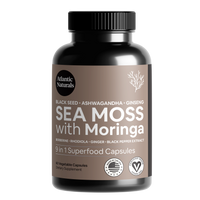
That's the thinking behind our Sea Moss with Shilajit 5-in-1 Superfood Capsules. They put organic sea moss and purified shilajit together with a few complementary botanicals in one capsule, so you're not buying, dosing, and remembering two bottles. Both traditions, one daily habit, every batch third-party lab tested.
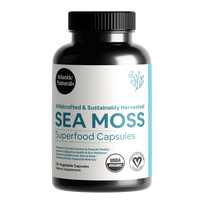
Prefer to start simpler? If you'd rather try sea moss on its own first, our flagship Organic Vegan Sea Moss Capsules, rated 4.7 stars across roughly 400 reviews, are an easy, single-ingredient-focused place to begin. Everything we make is side by side in the sea moss collection.
How to Choose a Quality Supplement
Whichever way you go, quality in this category is all over the map. Here's what actually separates the good stuff from the rest.
Wildcrafted, Responsibly Sourced Sea Moss
Look for sea moss that's wildcrafted, meaning harvested from the actual ocean, not grown in artificial pools. Pool-grown "sea moss" raised in salted tank water never absorbs the same range of ocean minerals, which defeats most of the point. Certifications help, too. USDA Organic certification, which Atlantic Naturals carries, adds independent oversight of how the product gets handled and processed.
Third-Party Lab Testing
Good brands test finished batches through independent labs and can actually show you the results. Testing should confirm identity (you're getting the species on the label), purity (no contaminants or fillers), and safety. If a brand can't or won't talk about its testing, treat that as a red flag no matter how slick the marketing is.
Heavy-Metal Testing Matters Especially for Shilajit
This one really matters. Raw, unpurified shilajit can carry heavy metals like lead and arsenic, picked up from the very rock it forms in. Proper purification and lab testing handle that, but cheap or unverified shilajit is a genuine risk, not a theoretical one. Never buy raw shilajit of unknown origin. Only choose products, combination formulas included, whose shilajit has been purified and screened for heavy metals by an independent lab.
So Which One?
If you eat mostly plant-based, or you're chasing iodine and gut-friendly fiber, start with sea moss. If you're drawn to fulvic acid or the Ayurvedic tradition and care most about everyday energy and recovery, start with shilajit. And if both describe you, which honestly happens a lot, don't overthink it. Because their strengths barely overlap, a combined formula like our Sea Moss with Shilajit 5-in-1 Capsules gets you both without a second bottle to manage. Whatever you land on, buy from a brand that tests its batches and will show you the results.
Frequently Asked Questions
Is sea moss or shilajit better?
Neither is objectively better; they do different things. Sea moss supplies iodine, marine trace minerals, and soluble fiber from a whole-food source, while shilajit supplies fulvic acid and earth-derived trace minerals with a long history of Ayurvedic use. The better choice depends on your goals, and many people take both together in a combined formula.
Can you take sea moss and shilajit at the same time?
Yes, they are commonly taken together, and their key compounds are complementary rather than redundant. Combination products such as our 5-in-1 capsules pair them in a single serving. As with any supplement, talk with your healthcare provider first if you are pregnant, nursing, taking medication, or managing a health condition, especially a thyroid condition, given sea moss's natural iodine content.
Does shilajit boost testosterone?
Shilajit has traditionally been used in Ayurveda to support male vitality and stamina, and researchers are studying its traditional uses, but the science is still developing. No dietary supplement should be relied on to treat a hormonal condition; if you have concerns about hormone levels, speak with a healthcare provider.
Who should not take sea moss?
Because sea moss is naturally rich in iodine, people with thyroid conditions, those taking thyroid medication, and anyone advised to monitor iodine intake should consult a healthcare provider before using it. Pregnant and nursing women should also check with their provider before adding any new supplement.
How do I know if shilajit is safe?
Choose purified shilajit from a brand that publishes or provides third-party lab results, including heavy-metal testing for lead and arsenic. Avoid raw or unverified shilajit of unknown origin. Every Atlantic Naturals batch, including the shilajit in our 5-in-1 formula, is independently lab tested before it reaches you.
These statements have not been evaluated by the Food and Drug Administration. These products are not intended to diagnose, treat, cure, or prevent any disease.


Leave a Comment