


Most Americans Think Iodine Deficiency Was Solved 100 Years Ago. New Research Says Otherwise.
Growing up in the Caribbean, I never thought twice about iodine. Sea moss was just something my grandmother put in everything -- smoothies, soups, porridge. It was food. It was tradition. It was how we took care of ourselves.
When I moved to the US, I assumed iodine deficiency was a solved problem here. After all, America introduced iodized salt back in 1924. Problem fixed, right?
Not even close.
Recent research has revealed something that most people -- including many healthcare providers -- haven't fully reckoned with: iodine deficiency is quietly making a comeback in the United States, and the people most affected are often the ones trying hardest to eat well.
Let me walk you through what the science is actually showing, who's most at risk, and what you can do about it.
The Numbers Are Worse Than You Think
Here's what stopped me in my tracks.
A 2025 study published in The Journal of Nutrition00561-9) by Daniel and Mangano analyzed nearly two decades of NHANES data and found that the prevalence of inadequate iodine intake among US adults nearly doubled between 2001 and 2018.
Let that sink in. Not a small uptick. Nearly doubled.
The numbers for specific groups are even more alarming:
- 35% of women of reproductive age had inadequate iodine intake during the 2017-2018 survey period.
- 46% of pregnant women were not meeting adequate iodine levels -- at the exact time when iodine is most critical for fetal brain development.
- The overall trend line has been moving in the wrong direction for almost twenty years.
This isn't a fringe finding. It builds on earlier work by Hollowell and colleagues in the Journal of Clinical Endocrinology & Metabolism (1998) that first documented the decline from NHANES I (1971-1974) to NHANES III (1988-1994), when median urinary iodine concentrations dropped by more than 50%.
The World Health Organization still lists iodine deficiency as one of the most significant nutrient deficiencies worldwide. We just assumed the US was exempt. We were wrong.
How Did We Get Here?
If iodized salt solved the problem a century ago, how is iodine intake declining?
Hatch-McChesney and Lieberman explored this question in Nutrients (2022), and the answer comes down to several converging shifts in how Americans eat:
The dairy processing shift. Dairy products used to be a significant incidental source of iodine in the American diet -- not because milk naturally contains much iodine, but because iodine-based sanitizers were widely used in dairy processing. As the industry has moved toward other sanitizing agents, the iodine content of commercial dairy has declined.
The plant-based milk boom. Almond milk, oat milk, coconut milk -- these alternatives have exploded in popularity, and for good reason. But here's what most people don't realize: the vast majority of plant-based milks contain zero iodine unless specifically fortified. When you swap cow's milk for oat milk, you're often dropping a meaningful iodine source from your diet without replacing it.
The "put down the salt shaker" message. Public health messaging around sodium reduction has been broadly positive for cardiovascular health. But it's had an unintended side effect: many health-conscious consumers have cut back on iodized salt or switched to sea salt, pink Himalayan salt, or other specialty salts -- most of which contain little to no iodine.
More meals out, less cooking at home. The salt used in restaurant kitchens and processed foods is overwhelmingly non-iodized. So even if you're consuming plenty of sodium, you may not be getting iodine along with it.
The irony is hard to miss: many of the people most at risk are the ones making thoughtful, intentional choices about their diets. They're choosing plant-based. They're reducing sodium. They're eating whole foods. And they're quietly sliding into inadequate iodine intake without knowing it.
Who's Most at Risk?
Not everyone faces the same level of concern. Based on the research, certain groups should pay closer attention to their iodine intake:
Women of reproductive age (15-44). The Daniel & Mangano (2025)00561-9) data showed that roughly one in three women in this age group had inadequate iodine intake. Since iodine is essential for thyroid hormone production -- which plays a role in reproductive health -- this gap matters.
Pregnant and breastfeeding women. Kerver and colleagues published in the American Journal of Obstetrics & Gynecology (2021) confirmed that a significant portion of pregnant women in the US are not meeting iodine recommendations. The RDI for iodine increases from 150 mcg/day to 220 mcg/day during pregnancy and 290 mcg/day during breastfeeding, according to the NIH Office of Dietary Supplements.
Vegans and plant-based eaters. Without dairy, seafood, or iodized salt as regular dietary staples, plant-based eaters face a significantly narrower window of iodine sources. This isn't a reason to abandon a plant-based diet -- it's a reason to be intentional about where your iodine comes from.
Low-salt and specialty-salt dieters. If you've swapped iodized table salt for sea salt, pink salt, or simply reduced salt intake overall, you may have unknowingly removed one of your primary iodine sources.
And while the most dramatic research data focuses on women, men on plant-based, low-salt, or dairy-free diets face the same risk factors -- fatigue, brain fog, and sluggish metabolism don't discriminate. If you're a man reading this and thinking "this doesn't apply to me," take another look at the dietary patterns above.
Could This Be You? Common Signs of Low Iodine Intake
Your thyroid gland relies on iodine to produce the hormones T3 and T4, which influence nearly every system in your body. When iodine intake is consistently low, your thyroid may not function optimally, and that can show up in ways you might not immediately connect to nutrition.
Here are some of the most commonly reported signs associated with suboptimal thyroid function:
- Persistent fatigue and low energy -- Feeling tired even after a full night's sleep is one of the most frequently reported experiences. Research suggests that up to 80% of people with low thyroid hormone levels report fatigue as a primary concern.
- Brain fog and difficulty concentrating -- Struggling to focus, feeling mentally sluggish, or having trouble with memory.
- Unexplained weight changes -- Particularly weight gain that doesn't seem to match your eating or exercise habits.
- Hair thinning or loss -- Thyroid hormones support hair follicle health, and changes in thyroid function are associated with hair changes.
- Feeling cold when others don't -- Cold hands, cold feet, always reaching for a sweater. Thyroid hormones play a role in regulating body temperature.
- Dry skin -- Skin that feels rough, flaky, or dehydrated despite adequate water intake.
- Mood changes -- Feeling low, anxious, or emotionally flat without a clear cause.
If you're reading this list and nodding along, you're not alone. These experiences are incredibly common, and they have many possible explanations.
These are general wellness signs associated with nutritional status and thyroid function. They are not diagnostic criteria. Always consult your healthcare provider for proper evaluation and diagnosis. If you believe you may have a thyroid condition, your doctor can run a simple blood test to check your thyroid hormone and iodine levels.
Why Iodine Matters So Much: The Thyroid Connection
To understand why iodine is so important, it helps to understand what it actually does in your body.
Your thyroid -- that small, butterfly-shaped gland at the base of your throat -- is essentially your body's metabolic thermostat. It produces two critical hormones: thyroxine (T4) and triiodothyronine (T3). These hormones influence your metabolic rate, energy production, body temperature, heart rate, brain function, and more.
Here's the key: iodine is a structural component of both T3 and T4. The "3" and "4" literally refer to the number of iodine atoms in each hormone molecule. Without sufficient iodine, your thyroid simply cannot produce these hormones at optimal levels.
According to the NIH Office of Dietary Supplements, iodine is an essential trace mineral -- meaning your body cannot make it. You have to get it from food or supplementation, every day.
The recommended daily intake for most adults is 150 micrograms (mcg) per day, with higher amounts during pregnancy (220 mcg) and breastfeeding (290 mcg).
When you think about it that way, iodine isn't just another mineral on a label. It's a foundational input for one of your body's most important regulatory systems.
Natural Food Sources of Iodine
So where can you actually get iodine from food? Here are the primary dietary sources:
| Food Source | Approximate Iodine Content |
|---|---|
| Seaweed (varies widely by type) | 16 - 2,984 mcg per serving |
| Cod (3 oz baked) | ~99 mcg |
| Iodized salt (1/4 teaspoon) | ~71 mcg |
| Milk (1 cup) | ~56 mcg |
| Shrimp (3 oz) | ~35 mcg |
| Egg (1 large) | ~24 mcg |
| Tuna (3 oz canned) | ~17 mcg |
Source: NIH Office of Dietary Supplements
Notice a pattern? The richest sources are seafood, dairy, and iodized salt -- exactly the categories that are declining in many modern diets. If you're eating less dairy, choosing specialty salts, and not regularly consuming seafood or seaweed, your iodine intake may be lower than you realize.
This is why Lomartire and colleagues writing in Marine Drugs (2021) highlighted seaweed and sea vegetables as increasingly important dietary sources of iodine and other trace minerals as traditional sources decline.
Sea Moss: A Whole-Food Source of Iodine (And Much More)
This brings us back to where I started -- and to the reason I founded Atlantic Naturals.
Sea moss (Chondrus crispus) is a species of red algae that has been consumed in Caribbean and coastal communities for generations. It's not a supplement that was invented in a lab. It's a traditional whole food with a long history of use.
What does the research say about its iodine content?
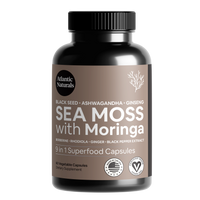
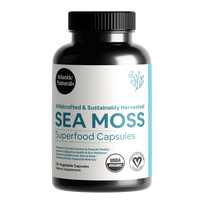
Research on Chondrus crispus shows meaningful iodine content. Darias-Rosales and colleagues published a study in Environmental Science and Pollution Research (2020) analyzing the mineral composition and found an average iodine content of 3.86 +/- 1.49 mg/kg dry weight (Darias-Rosales et al., 2020), and Atlantic Naturals sea moss capsules deliver this nutrition in a convenient daily dose -- just 2 capsules daily.
But here's what makes sea moss special compared to isolated iodine supplements: it doesn't deliver iodine in isolation. Sea moss is a whole-food matrix that also provides:
- Potassium -- supports healthy muscle and nerve function
- Calcium -- essential for bone health
- Magnesium -- involved in hundreds of enzymatic reactions
- Iron -- supports oxygen transport in the blood
- Zinc -- plays a role in immune function
- Sulfated polysaccharides -- compounds with antioxidant properties studied for their role in gut health
This is the difference between a whole food and a single-nutrient supplement. When you consume sea moss, you're getting iodine in the context of a broad spectrum of complementary minerals -- the way nature packages it.
Why Sourcing and Quality Matter
Not all sea moss is created equal, and this is something I feel strongly about as a founder.
Wildcrafted from Nova Scotia's cold Atlantic waters. Our sea moss is hand-harvested from the rocky coastline of Nova Scotia, Canada, where Chondrus crispus grows naturally in cold, clean, mineral-dense waters. Cold Atlantic water supports higher natural mineral density compared to pool-grown or tropical alternatives. This is the same species and the same ocean environment that the Darias-Rosales study analyzed.
Third-party tested for safety. One of the legitimate concerns about seaweed and sea vegetables is the potential for heavy metal accumulation. We take this seriously. Atlantic Naturals products are third-party tested for heavy metals, and the Operation Supplement Safety Program (OPSS, 2024) has validated the importance of third-party testing as a baseline standard for supplement quality.
GMP-certified facility. Our products are manufactured in a facility that follows Good Manufacturing Practices, the FDA's quality standards for dietary supplements.
Publicly available Certificates of Analysis. We don't ask you to take our word for it. Atlantic Naturals publishes COAs so you can see exactly what's in every batch. Transparency isn't a marketing strategy for us -- it's a baseline expectation.
Take the Next Step: Check Your Iodine Intake
If anything in this article resonated with you -- if you recognized yourself in the risk factors, or if those symptoms sounded familiar -- the first step is awareness.
Here's what I'd suggest:
1. Talk to your healthcare provider. A simple urine test or blood panel can give you insight into your iodine and thyroid status. If you suspect a deficiency, this is always the right first move.
2. Audit your diet. Look at your actual iodine sources over a typical week. Are you consuming iodized salt, dairy, seafood, or seaweed regularly? If not, you may want to explore ways to add iodine-rich foods to your routine.
3. Learn more about iodine and sea moss. We've put together a detailed resource page that dives deeper into the science of iodine, how sea moss supports thyroid function, and how to incorporate it into your daily routine.
Read: Iodine and Sea Moss -- What the Science Says -->
Shop Organic Sea Moss Capsules -->
A Final Thought
I started Atlantic Naturals because I watched my own community benefit from sea moss for decades before "the wellness world" ever noticed it. My grandmother didn't know the biochemistry of thyroid hormone production. She just knew that sea moss kept her family strong.
What I've learned since then -- from the research, from our customers, from the data -- is that she was onto something real. And now, as iodine intake declines across the US, the traditional wisdom of coastal communities has never been more relevant.
This isn't about selling you a product. It's about sharing information that I believe more people need to hear. The education is the point.
Your body needs iodine. It can't make its own. And the modern American diet is providing less of it than it used to. That's not opinion -- that's what the data shows.
What you do with that information is up to you.
-- Richard, Founder, Atlantic Naturals
References
1. Daniel, C.R. & Mangano, K.M. (2025). Trends in Iodine Intake Among US Adults. The Journal of Nutrition. DOI: 10.1016/S0022-3166(25)00561-900561-9)
2. Hatch-McChesney, A. & Lieberman, H.R. (2022). Iodine and Iodine Deficiency: A Comprehensive Review of a Re-Emerging Issue. Nutrients, 14(17), 3474. DOI: 10.3390/nu14173474
3. Kerver, J.M. et al. (2021). Iodine Intake and Thyroid Function in Pregnant Women. American Journal of Obstetrics & Gynecology. DOI: 10.1016/j.ajog.2020.07.022
4. Darias-Rosales, J. et al. (2020). Mineral Composition of Chondrus crispus. Environmental Science and Pollution Research. DOI: 10.1007/s11356-020-10478-9
5. Hollowell, J.G. et al. (1998). Iodine Nutrition in the United States: Trends and Public Health Implications. Journal of Clinical Endocrinology & Metabolism.
6. Lomartire, S. et al. (2021). An Overview of the Health Benefits of Seaweeds Consumption. Marine Drugs, 19(6), 341. PMC8232781
7. NIH Office of Dietary Supplements. Iodine: Fact Sheet for Health Professionals. https://ods.od.nih.gov/factsheets/Iodine-HealthProfessional/
8. World Health Organization. Micronutrient Deficiencies. https://www.who.int/health-topics/micronutrient-deficiencies
These statements have not been evaluated by the Food and Drug Administration. This product is not intended to diagnose, treat, cure, or prevent any disease.
This content is for educational purposes only and does not constitute medical advice. If you believe you may have an iodine deficiency or thyroid condition, please consult your healthcare provider.


Leave a Comment